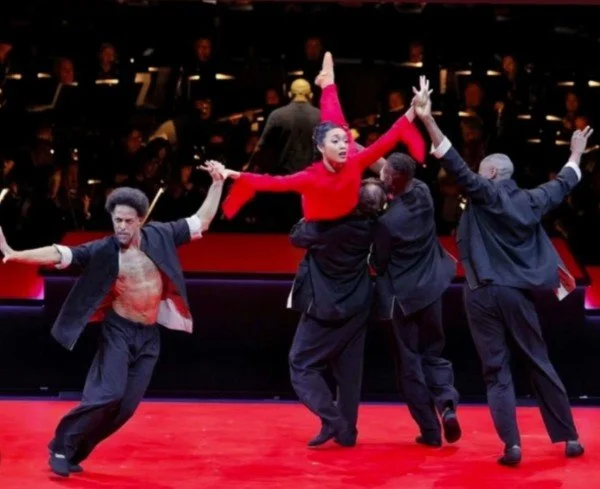
“We don’t need to do that carry again. Let’s take it from when you all have her up in the air,” Jessica tells us. She has one hour to sort our transitions on and off the concentric square stage.
The three other men and I lift Kayla and arc her over, mid reverse dive.
“Can we take it from Slut? Sorry Kayla.”
Kayla laughs. She is able to separate and she understands the forced errors this layered process creates for our choreographer: we are American dancers playing revolutionary 20th century Chinese performers inside a Tarantino-violent propaganda ballet about paragon Mao Zedong being shown to the Nixon administration during their 1972 visit to Beijing.
Then there’s the technical part.
Jessica gets that the moment Bob__our game AF Kissinger__sings “Slut!” is the best cue in the John Adams score to orient us for this dismount. She’d have needed an extra week of prep to count this music for dance; we’d have needed more rehearsal time to internalize it enough to correctly “Whip her to death!” on stage in front of people.
We are in good company. More than one principal has gotten lost during rehearsal in Adams’ meter gymnastics, which is akin to eating while utensils keep changing locations on their own.
The guys have far too much to manage before “Slut” just with me walking backward upstairs with half of Kayla (Tony whispers “Step!” to warn me every show).
Then there is the HR part.
Jessica and I danced in and out of a 90’s arts and entertainment landscape understood to be mostly unsafe, names called, chairs thrown and casting couches maintained. Celebrating new HR protections through daily practice means feeling crazy with forced errors. So even the suggestion of directing “Slut” to any actual person in the room is jarring no matter how clearly it appears on the page.
Layers.
And we are not the only ones.
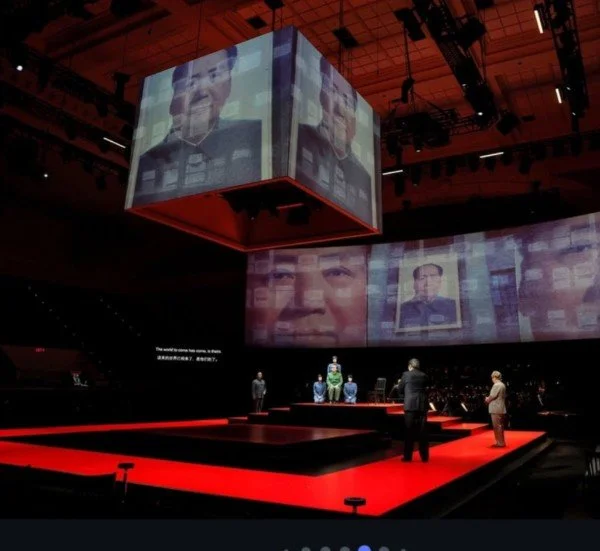
Artistic Director Francesca Zambello’s solutions to Kennedy Center displacement are genius, but also more than an office move. A stage in the center of amphitheater style DAR Constitution Hall means making most of my entrances and exits from the patron lobby. Like their comrades at The Met, WNO stage managers call our entrances. Since it’s a long way to center court, intuition-spiked math helps them figure out how far back to cue us.
No proscenium means we torture Kayla in your living room, dinner theater style. And that the orchestra is situated behind the stage. The mics help this none, although they ease principal burdens and better serve the audience.
No sets means video content must provide the opulent vistas opera promises.
Modest backstage space relegated several principals to our dancer dressing rooms. It also means there is nowhere for Jessica to add more dance business in the banquet scene, per Francesca’s suggestion, except on stage. Yes, rather than be away while her intrepid team adapted in these woods, she’s here with a crisis weedwhacker too.
And my first conversation as dance captain was with one of my Black colleagues concerned that while Kayla and Jared are both AAPI artists, the rest of us are anything but, another potentially forced error (please visit my blog about briefly playing an SS officer on the Met Opera stage).
It makes sense that this is complicated work, fortifying the citizenry with art that runs neck and neck alongside the political shenanigans that triggered WNO’s local tour—the company will perform five full-length operas across as many venues this season. This foray into U.S. foreign relations could not be more appropriately timed, especially with Carrie also out in theaters.
WNO General Director Timothy O’Leary points out John Quincy Adams’ reported compulsion to study politics and war so that his grandchildren could study art. This presentation of his composer namesake’s Nixon in China succeeds at addressing all of these opportunities.
In a building whose address is 1776.
Meanwhile Kayla is fine. She and her sistren are only promiscuous in the number of times they climb on to those pointe shoes for the cause, stage cliffs be damned.
“Let’s teach these motherfuckers how to dance!” Madam Mao says in Act III.
Let’s indeed.